
Inside the 2025 International Firewalk Gathering at Badaguish
There is a particular kind of silence in the Cairngorms just before dusk. The air sharpens. Breath turns visible. Pine and peat hang quietly in the background. And then, in a clearing at Badaguish near Aviemore, the wood begins to stack.

In autumn 2025, in the heart of the Scottish Highlands, around sixty firewalk instructors from fifteen countries gathered for an event most people outside the community will never fully see. The International Firewalk Gathering is not a festival. It is not a retreat in the conventional sense. It is a gathering of leaders. People who have completed the Firewalk Instructor Training Certification and are accustomed to standing at the front, suddenly become participants again.
And in 2025, Scotland was host. I did not create the gathering. I inherited it.
When I received the message confirming that Scotland had been chosen to host the 2025 International Firewalk Gathering, I felt two things almost simultaneously.
Excitement.
And weight.
I had not been in Mexico when it was announced. A few hours before it went public, I was told it was coming to Scotland and that I had been chosen to host. In that moment, what had started as a suggestion from my wife Marina became very real. The scale of the workload. The responsibility. The eyes of the firewalking world that would quietly turn in our direction.
I had helped organise the gathering when it came to England in 2019. This time was different. This was Scotland. This was mine to steward.
Arrival in the Highlands
We chose Badaguish near Aviemore because it could handle the practical demands of what we needed to build. But more than that, it sits in the heart of the Cairngorm mountains. Clean air. Water from mountain springs. Temperatures hovering between seven and ten degrees. The real Highlands.
Most participants arrived by bus. When they stepped off, they were greeted by a lone bagpiper and offered a wee dram of whisky or a bottle of Irn Bru. It was important to me that from the first breath, they knew they were not in a conference centre. They were in Scotland.
Tickets had sold out faster than any previous gathering. I suspect the destination had something to do with that. With that came a quiet vow. If Scotland was the stage, it would not be a backdrop. It would be woven into the fire.
That evening, before the first fire was even lit, we held a traditional Burns Supper. Haggis. Poetry. Ceremony. A grounding in culture before flame.
Night One: A Celtic Shield in Fire
Traditionally, the first night is hosted exclusively by the home nation. I wanted it to be unmistakably Scottish.
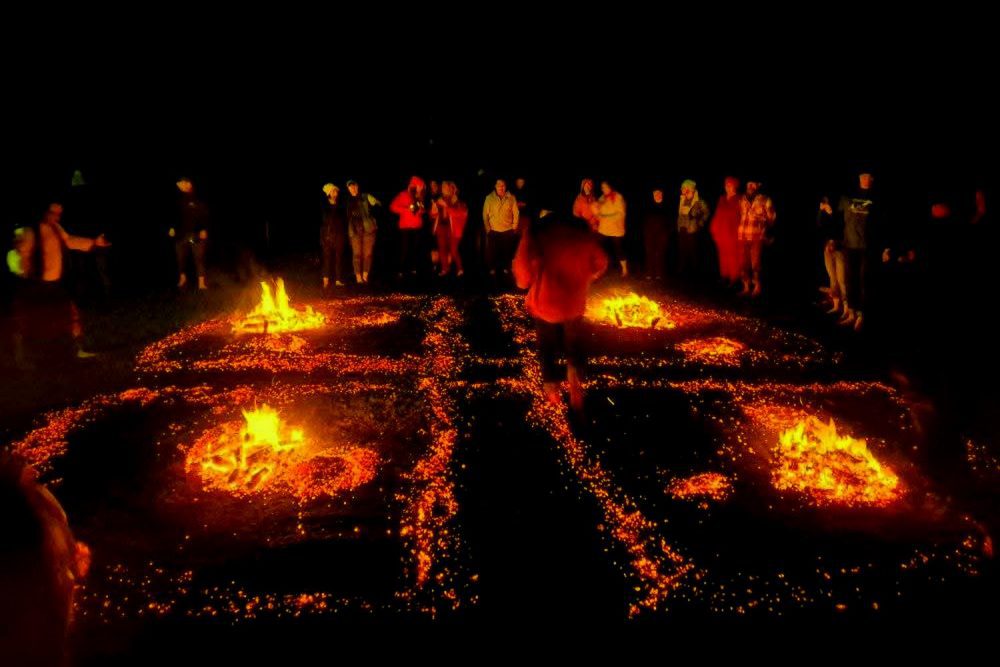
We began with eight separate fires. Two long parallel lanes, crossed by two perpendicular lanes, forming a central square without coals. Fires sat in the outer corners. Then curved lanes joined the ends, forming four quarter arcs pointing inward.
 As it resolved, the geometry became clear. A Celtic shield knot, rendered in fire. With the firewalking already underway, a bagpiper stepped forward. The sound carried across the clearing. People did not simply walk. They moved. They danced. There was joy in it.
We had ordered nine cubic metres of wood for the entire event, estimating roughly three per night. By 4:30 pm on the first day, I realised we had likely used around five. When you gather sixty firewalk instructors who rarely get to participate purely for themselves, they build with enthusiasm. The structure followed the plan, but it grew. I could either quietly dismantle part of it while everyone was at dinner, or honour what had been created and find more wood.
I chose to call the supplier and arrange an additional four cubic metres for delivery the next day. Leading leaders requires flexibility. If you create a framework that inspires people, you must also be prepared for it to expand.
Night Two: Samhain
The second night fell on 31 October. Samhain in Scotland. The ancient turning point where the veil between worlds is said to thin.
We built two parallel railroad fires, about three metres long with two metres between them. As we stacked the wood, we set an intention. An invitation to those who had passed beyond the veil to join us that night.
 Once the coals were ready, only one lane was walked. The other was left untouched, reserved symbolically for the spirit realm.
Over the next half hour, the lanes were extended and curved into an arch that connected to an altar fire positioned beyond. The space between them was then filled, raked into a six metre square carpet of coals. The veil between words had been lifted.
Earlier that day, participants had crafted masks. In ancient folklore, disguises allowed the living to move unnoticed among spirits. That night, they wore them as they stepped onto the glowing surface. Not alone, but beside the memory of those they had invited.
They did not rush. They danced. There was no spectacle here for outsiders. No applause. Only the crackle of embers and the weight of remembrance carried lightly in the hearts of those present.
It was powerful. Quietly so.
Night Three: Fire and Water
The final night’s firewalk is always a collaboration. This year, the entire group decided to create a six pointed star symbolising masculine and feminine. It reflected the ancient alchemical symbols for fire and water. Opposites. Balance. Integration.
 Unlike the first two nights, this design was not just from the Scottish team. It belonged to everyone present.
After that final firewalk, we gathered together to celebrate a surprise vow renewal. I was unexpectedly presented with the Rake Award by Ǎsa Beckman. It is not given annually. It is not guaranteed. Since the inception, it has been awarded only a handful of times, including to figures such as Tolly Burkan, John ‘Hawk’ Maisel and Rolf Beckman, names regarded as elders in the field.
The award recognises sustained contribution to the firewalking world.
Standing there, in the Highlands, among peers from fifteen countries, I realised something had shifted. The event had not merely run smoothly. It had landed.
This amazing evening was closed only after the whisky tasting and a traditional Scottish ceilidh were experienced by all.
Not Alone
Although I was the lead organiser, I was not alone. Marina was invaluable throughout. From the earliest suggestion that Scotland should host, to the planning, research and delivery, she stood beside me. We were also supported by the committee and by local helpers who were instrumental in bringing it all together.
 If someone had observed me quietly behind the scenes, they would have seen something else developing. A deepening pride in my country. In its culture. In its history. The more I researched, the more I realised how much there was to honour.
For those outside the firewalking world, it may appear theatrical. Sixty leaders from fifteen countries dancing barefoot on the coals in the chilly Highland air.
For those inside it, it was something more. It was a reminder that the fire is not a stunt. It is structure. Intention. Design. Community. Leadership.
I did not create the International Firewalk Gathering. I was entrusted with it for a season.
My role was not to reinvent it, but to honour its traditions, embed Scotland into its bones, and ensure that when the final embers cooled, it had been worthy of the journey people had made to be there.
In the Highlands, as the last coals dimmed under a cold October sky, what remained was not just ash.
It was continuity.